
 |
|---|
home / art / travel / world / books
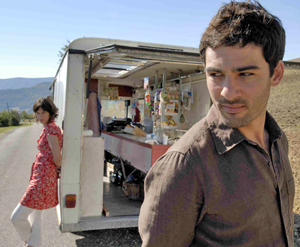
Films 2008: The Grocer's Son Antoine, a gruff young man (Algerian?) with neither ambition nor prospects finds he must return from the city to his hometown in Haute Provence to mind the family store when his father suffers a heart attack. It isn't easy. All sorts of family rivalries and resentments resurface as Antoine, his can-do-no-wrong brother who never left home, his adoring mother, and a young woman named Claire who's come down with him from the city, try to adjust to one another and keep the family business alive while the paterfamilias, a grouch in the best of times, convalesces in the hospital.
Much of the action involved the roving truck that Antoine must drive from village to village hoping to sell produce to the elderly residents. His antagonistic style an obvious lack of interest in the service he's performing soon undercut his sales with the villagers, though there is plenty of humor to be got from these brusque interactions. Eventually Claire, who has been studying for her exams amid the peace and quiet of the village, decides to come along and show him how to establish rapport with his clients. The film takes on a new dimension when the father returns to the village, and several subplots are also thrown haphazardly into the mix. The entire film has an unhurried pace and a 16mm look, and the principle characters are unpolished and all but inarticulate, which helps to sustain its working-class tone and allows us to enjoy both the humor of Antoine's interactions with the eccentric villagers and the drama of his sometimes explosive family life. And the countryside of Haute-Provence does the rest. Beauty in Trouble The title says it all. Marcela is a working-class beauty with two small children and an irascible (but sexually voracious) husband who earns his living running a chopshop in Prague. The boy has asthma, the shop in full of mold (courtesy of the 2002 floods), and Marcela finally decides to flee with her children to her mother's apartment. Her mother's current husband, a domineering diabetic, resents the intrusion—well, the kids ate all his sugar-free cookies!—though he offers to take them to the racetrack. (Nice fellow.) The plot is thickened by a middle-aged gentleman named Evzen that Marcela (Ana Geislerova) meets at the police station while posting bail for her husband. (He's reading Kundera: she's biting her lip.)We've already met Benes. We've been to his Italian villa, and we've been given a very clear idea what a kind-hearted and gentlemanly guy he is. And long before this more-or-less random meeting takes place, we've already guessed what shape the film is going to talk.
Will Marcela wait for her handsome, violent jailbird husband (played by Roman Luknar, who looks like a youthful Gerard Depardeau with features toned down and regularized.) Or will she fall for the suave gray-haired man who could give her almost everything, and also insure a secure future for her children? The question that's never raised, much less answered, is why Benes, who must have a wide array of sophisticated friends, and doesn't seem to be on the make, would be spending time with an airhead telephone reservationist at an airline who has two young kids and mixes her Chianti with Coca-cola. There is no real chemistry between the two, and we must conclude that Evzen is there merely to further the plot. It's not only the main character, but also the film itself, that's “beauty in trouble.” It's an elegant but highly schematic production, and what saves it is not the allure of its "beauty" or either leading man, but the charm of the film's least didactic and most interesting characters—the two little kids The Edge of Heaven I don't think they've come up with a name for it yet. Or if they have, I haven't heard of it. I'm referring to that type of film in which a number of stories take place simultaneously, most of which intersect, though often only tangentially and superficially. At times the consequences of such passing interactions be profound, of course. (That's usually a part of the message.) Robert Altman's Nashville and Short Cuts ; Keislowski's chromatic trilogy Red , White , and Blue ; Alejandro González Iñárritu's Babel . Crash . Magnolia . Pulp Fiction . Love Actually . The list goes on and on. In fact, all the way back to Grand Hotel (1932). It seems to me that quite a few of the films I've mentioned above—shall we call them “propinquity films?”—are better than average. This may be because only a seasoned and confident director would attempt to breathe life into such a diffuse format. Or perhaps it's because what has been lost to focus and the “narrative arc” is more than compensated for by the fact that lives fleshed out in brief images and clues are more mysterious and suggestive than those that are build block by block to form a coherent but predictable whole. And in the end, there is more than a grain of truth in the corny metaphysical notion that our actions affect the lives of others, and take on gravity and meaning, in ways that we neither intend nor fully understand. In “propinquity films” we see between the lines—we see things the characters themselves only dimly see.
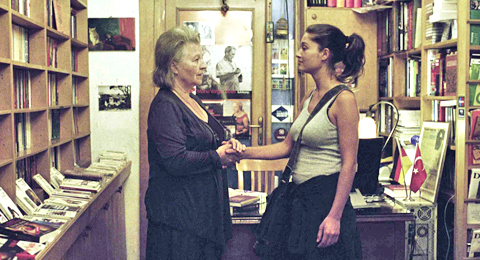
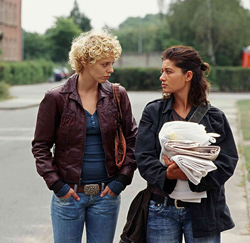
Whatever the case may be, The Edge of Heaven, written and directed by Fatih Akin, is a very fine film along these lines. Yet hardly have I mentioned it than it seems to me I'm going to have to defend its inclusion in this genre. The film has only six major characters—a middle-aged Turkish woman living in Germany; her daughter, a revolutionary living in Turkey; an elderly Turkish man living in Germany with his son, who has become a professor of German literature there; and a German woman who lives with her daughter, a student, in the same town. At the start of the film, these three small family groups know nothing about one another. By the time the film comes to a close, their lives have become intimately intertwined. And several of them are dead. How do these people come to know one another? I wouldn't want to say too much. But what is interesting is the patience with which Akin spins out the story. Unlike Babel , which was jumpy, intense, and in-your-face, (perhaps to its detriment), The Edge of Heaven is built of seemingly incidental domestic moments and conversations. A man eats ice cream in a park with his son, and asks him, “Who are you screwing these days?” An affluent student befriends a stranger who seems to have no place to stay. A woman makes a cherry pie while disputing the merits of the EU with a mysterious and unwanted houseguest. The film's central character, if there can be said to be one, is Nejat, the professor of German who lectures his bored students about Goethe's rejection of revolution as a means of political change. Certainly Nejat has never revolted against his father, a coarse and unsavory peasant who divides his times between prostitutes, the racetrack, and booze. A professional success in German society by any standard, yet also a dutiful son to his Turkish father, Nejat is frozen between worlds. His female counterpart, Ayten, is every inch a revolutionary. Yet she, too, finds herself between worlds. She has fled Turkey following a botched political demonstration, but has no official identity or means of support in Bremen, where she's come to find her mother, whom she believes is working in a shoe shop. (But Ayten's mother has never worked in a shoe shop.) The film moves effortlessly back and forth between Germany and Turkey as the characters meet or miss their destinies, and sometimes find themselves in circumstances as arbitrary as they are unpleasant. Yet for all of that, most of the film remains rather low-key. On several occasions a character brings his or her entire life into focus in a moment of realization, a single line. Many of the issues we find ourselves pondering as we leave the theater were never raised explicitly. How people hate and love and fight and misunderstand. Fathers and sons, mothers and daughters, comrades and lovers. And the pull of home.
Happy-Go-Lucky Mike Leigh had made a number of unusual films about the members of the British working class, and few of them are sunny. Nor is Happy-Go-Lucky, which follows a few weeks in the life of a cheery grade-school teacher named Poppy (short for Pauline.) Critics have called her “optimistic,” but that isn't quite the right word to describe this endless fountain of chatter, giggles, witty asides, working-class clichés, and brilliantly imaginative remarks. Poppy is so quick on the uptake that she would wear anyone out before long—yet she is surrounded by a loving coterie of friends, relatives, and colleagues who genuinely enjoy her company and return her banter tit-for-tat. Her wardrobe is outlandish—yet we may find ourselves taking a liking to the hideous mismatches. Her consistently manic behavior may set our teeth on end—yet as the film develops, it becomes clear that Poppy is capable of thoughtful responses to the difficult situations she sometimes find herself in. In fact, the word “develops” is a little out of place in describing a film that focuses on learning how to drive a car, attending flamenco dancing lessons, dealing with a little boy who acts rough on the playground, getting pissed at the pub, visiting a middle-class sister out in the suburbs, and talking to a homeless man under a bridge. In short, Happy-Go-Lucky is less narrative than character study. Or better yet, considering how much the supporting cast and the surrounding hurly-burly of London street-life contribute to the experience, a life study. It gives us the feeling, very rare in film, that we're actually seeing life. The flow of life, the richness of its details, the majesty of it's flow, the power of the affections sparking back and forth across it. That's the way Poppy sees it. She isn't the happiest person in the world, nor the smartest, perhaps, but she does possess a rare gift of levity, and as the film's giddily mundane events follow one another across the screen, it starts to rub off on us.
Transsiberia The plot is intriguing: a young married couple returns to Moscow from a missionary conference in Beijing on the Transsiberian railroad. He (Woody Harelson) is a good-natured but rather naive Christian who loves trains; she (Emily Mortimer) is a bad girl hoping to bring some sort of order into her life. They hook up with a mysterious young couple in the dining car who seem to have been traveling for years. As the train moves across the snow-covered countryside from stop to stop, the local color remains outstanding, but the atmosphere of menace grows thicker, and the presence on the train of Ben Kinsley, as a Russian narcotics agent trying to track down smugglers, adds a few more layers of tension to the drama. There are a few surprising twists and a few truly gruesome scenes that viewers like me simply turn away from. It's a film with no real heroes, and lots of villains, but it's very well made, and when it's over you really feel like you've been somewhere—though you may never want to go there again. Son of Rambow Funny, charming, touching, and meaningful in an unassuming way, Son of Rambow is a story about kids that makes you feel like a kid again. It also unabashedly underscores the importance of friendship, exuberance, and heroism to the development of the male psyche. A young boy named Will, raised in cultural isolation among a puritanical sect that shuns all forms of electronic entertainment, exercises his creative energies by doodling imaginatively with colored pencils in his Bible. He becomes the hapless tool of the school bully, and soon afterward encounters something beyond his wildest fantasies: a pirated copy of Rambo: First Blood . Will becomes a stunt-man for his new friend's Rambo sequel, and the adventures multiply with hilarious unpredicability. Filmed with a mostly amateur cast and imbued with both insight and nostalgia, director Garth Jennings and producer Nick Goldsmith ( Hitchhiker's Guide To The Galaxy), have managed to capture the excitement and creativity of uninhibited childhood expression, along with the glories and humiliations that have defined friendship and family life from time immemorial. Jennings and Goldsmith were present at the film the day I saw it, and after the show they answered questions. To judge from their winsome personalities and straightforward answers, they seem to have been inspired by the simple desire to capture the innocence and fun of childhood adventure—nothing more or less—during the eight years it took to complete the film. The amazing thing is that after all that time and work—the practical compromises and logistical frustrations—the end product has precisely the tone and flavor they were looking for. Tuya's Marriage Martin Slivka: The Man Who Planted Trees This documentary chronicles the life of a Slovak documentary film-maker named Martin Slivka, who filmed folk-theater performances and musical events in his homeland for many years. He also made films about Byzantine iconography and took some memorable footage of the Russian invasion of Czechoslovakia in 1968. In the course of the film various friends and colleagues tell stories of Martin's youth and early career, and his wife relates how they met and fell in love. There are clips of Martin's films, and most viewers probably wish that there were more of them, because few of us have seen these films, and even fewer have seen Slovak folk theater first-hand. Men in wolf-head masks dancing in the snow? Lots of singing and OMM-PA music, but with a different edge to it. At one point in the film Slivka asks, “Where are those who should have written the audiovisual history of the earth?” Good question. And today we might also ask, “Where are those who should be airing Martin Slivka's films?” Callas Assoluta Maria Callas was the greatest diva of the twentieth century—or the most diva-like, at any rate—and this documentary chronicles her life and career with all the subtlety of a teen fan magazine. It were as if we were thumbing through an old copy of Life Magazine or Paris Match , with Technicolor images of Monte Carlo and Aristotle Onassis's yacht, and breathless clichés taking the place of mature analysis. Yet many of the events described in the film were unknown to me, and the story of Callas's development as a singer and a world-class personality is genuinely fascinating and heroic. On the other hand, the film's sound quality was horrendous (or else the theater's speakers are cracked) which is not a good thing for an film about an opera star who had a propensity to shriek. In any case, the excerpts from the operas themselves were few and far between. It also seemed to me that in interviews Maria Callas herself consistently comes across as more intelligent and interesting than either the people interviewing her or the people making the film. So that at the same time that we're learning about Callas's career and artistry, we're also gaining insights into the mindless small-talk drummed up in all ages by journalists trying to generate controversy rather than penetrate to the heart of an unusual and remarkable soul. International(E) Foreign films with a musical theme are always tempting, and the Turkish film International(E) highlights the strengths and weaknesses of many such festival offerings. It deals with the lives of a band of part-time folk musicians who are trying to find a place for themselves under a fascist regime that suspects sedition in anything with an ethnic tinge. Scene by scene, the film is plodding and only intermittently funny, but it benefits from the musical performances that take place sporadic, and the plot is actually constructed around an unusual and effective trope. The local band is caught red-handed while performing in the back of a truck and recruited to play marches for military events. They add the Communist Internationale to their repertoire without knowing what the song is, due to an unlikely chain of events that's too complicated to describe in detail. I'm not going to give away the ending, but suffice it to say that in the final scenes, as the light-hearted tone and small-town buffoonery give way to riots, torture, and perhaps even death, the film takes on a new dimension and fully justifies the time we've spent with it.
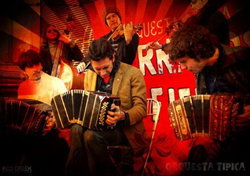
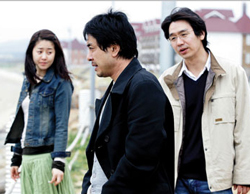
Orquesta Tipica: Tango or Death The tango group Orquesta Tipica Fernandez Fierro is a twelve-man street band specializing in traditional tango music that has allegedly revitalized the genre among the youth of Argentina during the last decade. This documentary purports to chronicle its rise. The most interesting scene in the film takes place early on, when one member of the street audience watching a show in a suburb south of Buenos Aires confronts a cop and defends the right of these musicians to perform in the street. The man goes on to decry the pernicious influence of tedious Cumbia rhythms on the minds of Argentina's youth. For anyone hoping for a genuine analysis of the relationships between musical styles and cultural consciousness, that conversation is about it. Most of the film is a sort of grainy, home-made Hard Days Night , with the band getting lost in various European cities, moving pianos up and down city streets, mugging in front of the cameras, and dozing in the homes of generous sponsors. It's fun, but it gets old. And if the truth be told, the sounds of tango music itself also grow tiresome when divorced from the dancing (there is no dancing in the film) and the nightclubs and the history. As is often is the case with festival releases, we are thankful for having been exposed to a world we hardly knew, but mildly frustrated by the shortcomings of those who could so easily have shown us a more complete picture. Woman on the Beach The brochure description of this film exposes the dangers of promotional hyperbole and perhaps explains why some viewers who get caught up in festival frenzy are reluctant to attend Film Society offerings on a regular basis. Woman on the Beach was billed as “a chance to discover Korean cinema,” which may be true. But if it is in any way representative, then the Koreans have a long way to go before they enter the art-house mainstream. Similarly, director Sang-soo Hong is described in the brochure as “one of the most exciting figures in the Asian New Wave.” Yet the film is the opposite of exciting. We follow a few days in the lives of a small group of characters at a largely-deserted beach resort. They're all self-centered, mildly depressed, and looking for a good time. The one exception is an erstwhile “boyfriend” who vanishes from the scene fairly early on in the proceeding
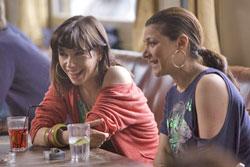
Well, good films can be made about callous individuals ( Five Easy Pieces ? Raging Bull?) and during the early going we watch in hope that the casual cruelty, cracker-box philosophizing, and predatory affections being exchanged by the main characters may build to some sort of moral awakening or tragic downfall. But as the film proceeds it takes on a genuinely aimless and self-indulgent quality rather than a moral edge, and when one of the two women who are vying for the attentions of the leading man (a locally-famous film director) announces that she's over thirty, we're genuinely surprised, not because she looks younger than that, but because she has been behaving like a teenager. To give the film its due, the feckless trio of central characters do converse with artless inanity. The two women are both attractive, they smile and giggle almost incessantly, especially when drunk (which is often). During the two-plus hours we spend with them they begin to glow with a sort of tedious fascination. All the same, one of these days Hong might want to take a look at an early Eric Rohmer film like Le Beau Mariage, or Truffaut's Bed and Board and Stolen Kisses, to remind himself how much economy, humor, and genuine thought can be brought to bear on even the shallowest personal relationships. Then again, it's been twenty-five years since I saw those charming films. I wonder how they would strike me today? Also Worth a Note: Tell No One. An urbane French thriller in which a woman who was murdered eight years ago returns to the living. Many twists and turns suspended in an aspic of savory intrigue and malevolence. My Winnipeg. “The Forks,” homeless on rooftops, endless snow and and exploding hockey arenas pass bizarrely across the screen in Guy Madden's long love letter home. |
|---|