The New Walker
The Walker Art Center sits on the rise of Lowry Hill just south of downtown Minneapolis. It’s been a prominent and valuable urban resource for as long as I can remember, bringing exhibits and performers to town that wouldn’t otherwise have approached within a thousand miles. An addition has been added recently to the building, making it possible to entice an even greater variety of acts and styles, I guess.
I’ve driven by the new building many times since it was completed, and am struck repeatedly by how little cheer it adds to the neighborhood. Although its various shapes and angles are harmonious and intriguing in an off-kilter sort of way, its textured metal surface invariably reminds me of a dirty snowbank. On especially bright and sunlit days the exterior walls take on the sheen of crumpled sheets of aluminum foil that have lost their luster in a campfire. It seems as if the Swiss architects, Jacques Herzog and Pierre de Meuron, were seeking to capture depression itself (admittedly one of the towering sentiments of the age) and put it on display for all to see.
One thing the architects clearly wanted to avoid was even a passing visual connection to the old Walker, with its dark warm bricks and elegantly boxy forms. In this they have succeeded. The original plan, in fact, was for a squat glassy melting ice cube that would glow from within on cold winter evenings. Fear of the expenses involved in washing all the glass put an end to that dream, and we are left with a striking but peculiar monument to that avant garde which is continually advancing, and, ipso facto, repeatedly being left behind.
Yet if the exterior of the new Walker seems cold, grimy, and unlovable, the interior is somewhat more appealing. The interior of the old Walker consists of a series of boxy white gallery spaces that are uninteresting in the extreme, considered in themselves. On the other hand, the interior spaces of the new Walker are reminiscent of the Cabinet of Doctor Caligari—bent, rounded, jagged, claustrophobic, sloping this way and that.
GOING INSIDE
There has always been a certain “knowingness” associated with modern art movements. Some people know what’s going on, others aspire to become cognoscenti, while the masses are content to bumble naively along in darkness, punching the time-clock or bringing in the crops in the fall, and watching football on Sunday afternoons. When such earthbound beings do make a rare visit to the Walker or some other mecca of culture we’re likely to overhear them offering a gauche observation on the order of “My niece can draw better than that!” (In fact, I’ve had the same thought myself. Then again, I have some very talented nieces.)
But we all have much to learn from a place like the Walker. For a start, we can read the signs that accompany the artworks telling us that so-and-so has a fascination with exploring the images of archtypal violence in media representations of trans-racial etc etc. Sometimes a better bet would be simply to respond to the images that have been set in front of us, cherishing those that move us and dismissing the rest with a good-natured chuckle. But to fully appreciate the art at the Walker, it really helps to know what’s going on NOW. In fact, the value of this knowingness manifests itself the minute you step into the building. In the lobby of the new Walker there are no signs indicating where the art is. You just need to “know.” (Hint: Once you’ve bought your ticket, you’re going in the wrong direction.)
We entered the new Walker like innocent babes, got our tickets, and proceeded up the stairs to the Dolly Fiterman gallery. On the landing we met up with four white human-sized figures (ceramic?) standing in a row in front of a floor-to-ceiling window looking out on an undistinguished sward of grass. These creatures seemed to be the mutant product of breeding experiments involving Tellitubbies, Smiley-face buttons, and the Pillsbury Dough Boy. I turned left, looking for the “real” gallery, and found myself walking down a dimly-lit hall past a coatroom. I eventually found my way into the men’s bathroom, which was very nice—crooked black walls, white stalls, no unseemly mess anywhere.
Returning to the landing, we proceeded up the stairs to a second hall which led to a long narrow restaurant—Wolfgang Puck, I believe. As we entered the room I saw a young woman at the bar with her head turned sideways at bar level, unabashedly shoveling a morsel of food into her mouth. The food must be good! The conversation was animated, the views out across the city were fine, and strange as it may seem, we ran into someone we knew waiting in line for a table.
No waiting in line for us. We weren’t hungry anyway. (We’d just come from Rum Tup Thai, my favorite among the many good Thai places in town. Try the green curry.) We continued up the stairs, passed the elevator doors several times, and enjoyed the interesting views of the sky out the oddly-shaped hexagonal windows.
Rounding the corner at the top of one flight of stairs we came upon a dozen young women in leotards and baggy sweatshirts crouching and sitting on the floor with their legs extended. It appeared a choreography audition was in progress somewhere nearby. Just down the hall we found the theater and were tempted to go inside to watch a few numbers, but at the bottom of the sign posted on the door it said: Not Open to the Public.
We finally reached the top of the stairs without finding anything resembling an art gallery and took the elevator back down to the lobby. At that point I walked over to a woman standing behind a table passing out maps, and, being a man of few words, I good-naturedly asked her, “Where’s the art?”
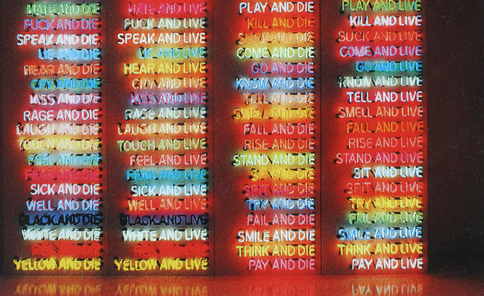
She explained to me that we’d gone the wrong way, up into the “performance tower.” The art was over to the right, down the hall toward the old Walker. For the record, this information is contained on the map, but it’s in an inner fold that Hilary only discovered during our drive home after the visit. Wouldn’t it be better to have a big Bruce Nauman neon sign with an arrow pointing the way? It could flash “Art” and then counterflash “Die.”
The walk down the hall to the art is a nice one. You can look out through the long row of windows and see the skyscrapers downtown. You can duck into a small gallery and see the work of a man named Cameron Jamie, who is fascinated by primitive masks—though he’s probably well aware that his masks don’t really measure up to the genuine primitive masks they’re based on. You can sit on a media couch sponsored by Best Buy to watch a video of an anime representation of speeding traffic. Then again, you can also look out the windows you’re passing by and see genuine traffic speeding by. Is that the point? If so, what is the point?
At the end of the hall we entered the huge Diane Arbus Revelations exhibit. Most people are at least superficially acquainted with her work: deadpan close-ups of transvestites, people in Central Park, Siamese twins, sword-swollowers, nudists, rich Southerners, etc. The show contains many, many photographs, and it seems to me that the impact of Arbus’s vision is eventually undercut by the sheer volume. We grow weary of her seemingly tirelessly efforts to avoid photographing anything that looks relaxed, pleased with itself, or conventionally beautiful. Aren’t there any squirrels in Central Park? How about someone laughing?
The show’s curators have done a very good job, however, of integrating material from Arbus’s personal life—photos, journals, books, cameras—into a couple of darkly-lit rooms that are far more interesting than the photos themselves. Stools have even been provided for those serious enough to stop and read the stuff, though the light is rather low. I read a section from Arbus’s high school essay on Plato’s theory of forms that struck me as right on the mark. I also read a few journal entries expressing the apprehension she felt that pregnancy and motherhood would change her, and the relief she felt when she found that they didn’t change her at all. I left those rooms feeling that Arbus is more interesting than her photos are. Or maybe it’s just that words are more interesting than pictures.
One of the big thrills for me, never to be repeated, was the moment when I realized I was standing in a room I’d been in before. I had made my way into the galleries of the old Walker without realizing it. That was “knowing.” That was cool.
Our final stop was out on the rooftop terrace. It’s a wonderful space with four or five expansive levels, and it was deserted when we were out there. We could look out at the city, down at the basswood trees in the sculpture garden, and across the highway at the faux-Gothic churches that after a hundred years have still not become weathered enough at the edges.
We explored the old roof and then followed a narrow catwalk over to the new roof. That course would eventually have brought us back to the restaurant in the new building. From a distance it looked like an odd way to come into a restaurant, however, and in any case the door might well have been locked. Just imagine how foolish we would have looked then, trying to barge into the restaurant from out on the roof like criminals! We decided to return the way we’d come, down through the galleries of the permanent collection. This took us through a series of interior connecting stairways that had been designed with little regard for right angles or uniform grade. In time all of this will become familiar, no doubt, but as we descended through the building I relished the feeling of not having any idea where I was. By the time we finally arrived back at the giftshop, I felt as exhilarated as a twelve-year-old who’s been scampering through the construction site of a half-completed church on a weekend when nobody’s there.
On our way out I noticed that circular holes have been cut into the vast concrete terrace in front of the new Walker, and grass has been planted in each circle to enliven it. Though the grass isn’t doing well, I guess this terrace has potential—though I couldn’t help wondering how the building might have worked had the main entry been placed on the opposite side, away from the hectic rush of cars, trucks, and buses heading uptown and downtown.
We crossed the highway to Loring Park, where the mid-summer flowers in the distance looked spectacular. As we approached the car my attention was drawn to a crowd of thirty or forty young women and men who were milling around the courtyard of a church. Well, most of them were milling around a woman in a white gown. The other women wore black and bronze dresses, and the men were in tuxedos. A few were taking pictures. Everyone looked very sharp. Everyone was smiling. There was a delectable nervous energy in air that we could sense even at a hundred yards.
“Here is where the life is,” I thought, almost in spite of myself. “Here is the art. The mystery.”